Metal Slug: Hand-Drawn Chaos and Arcade Perfection
How Metal Slug set the gold standard for 2D pixel art animation with hand-drawn sprites, absurd set-pieces, and co-op chaos that still outshines modern run-and-guns — series breakdown, version guide, and why the art holds up.
Last updated:
Quick Answer
Metal Slug (1996) is the most beautifully animated 2D run-and-gun ever made. Every frame was hand-drawn by Nazca Corporation’s pixel artists — enemies sweat and recoil, vehicles buckle, backgrounds burst with animated detail, and the humor is woven into every corner of every stage. Play Metal Slug 3 for the peak, Metal Slug X for the best entry point, and the original for historical context.
Last Updated
Content reviewed May 2026. Platform availability checked at time of writing. The ACA Neo Geo versions on modern storefronts are arcade-perfect — confirm current pricing before purchasing.
Who This Guide Is For
- Anyone who has heard Metal Slug described as “the best-looking pixel art game ever” and wants to understand why
- Players trying to decide which Metal Slug game to start with
- Contra fans looking for the next run-and-gun that lives up to the standard
- Retro enthusiasts curious about the Neo Geo’s most iconic non-fighting franchise
- Artists and game developers interested in how Nazca achieved that level of hand-drawn animation
Key Takeaways
- Metal Slug launched in 1996 on the Neo Geo, developed by ex-Irem staff who had worked on GunForce and In the Hunt
- Every sprite was hand-drawn frame-by-frame — no skeletal animation, no tweening, no shortcuts
- Metal Slug 3 (2000) is the consensus peak: the longest, most ambitious, and most creative entry in the series
- Metal Slug X (1999) is the best entry point — it fixes Metal Slug 2’s slowdown and adds content
- The series uses absurd humor as a design tool: enemies panic, soldiers read newspapers, and the player character can transform into a zombie or a fat version of themselves from eating too much food
- Seven main entries exist (1996–2008); the core trilogy — 1, X, 3 — is the essential play order
The Birth of Metal Slug
Metal Slug did not come from SNK’s internal teams. It was built by Nazca Corporation, a small studio formed by former Irem developers who had previously worked on GunForce II — a 1994 run-and-gun that now reads as a clear prototype for Metal Slug.
Nazca brought the project to SNK as a finished game. SNK published it for the Neo Geo MVS arcade system in 1996, and the result was immediate: arcade operators reported high revenue, and the game earned a reputation among players for being something visually special.
The Neo Geo hardware was unusually powerful for 1996 — it had launched in 1990 with specs closer to a 1995-era 2D machine, and its massive cartridge format (up to 716 megabits) allowed Nazca to store an enormous amount of hand-drawn sprite data. This is why Metal Slug’s animation density was possible — the hardware was designed for exactly this kind of game, even if it took six years for someone to fully exploit it.
SNK absorbed Nazca after Metal Slug’s success, and the sequel was developed internally. But the first game retains a distinct identity: slightly grittier, more grounded in military aesthetic, before the series leaned fully into absurdity in Metal Slug 2 and 3.
Hand-Drawn: What That Actually Means
The phrase “hand-drawn pixel art” gets thrown around loosely. For Metal Slug, it is literal.
Most 2D games from the era — and most modern 2D games — use techniques that reduce labor: skeletal animation where limbs are separate pieces rotated and moved; tweening where intermediate frames are generated between keyframes; palette swaps to create variants without new art.
Metal Slug used none of these. Every frame of every animation was individually illustrated:
- Player characters — walking, running, jumping, crouching, throwing grenades, climbing into vehicles, ejecting from vehicles, dying in multiple ways, transforming into zombies, becoming fat, and dozens of transitional animations between states
- Enemy soldiers — they sweat, flinch when shot, run in panic when an ally is killed, read newspapers when idle, cook food over fires, and react to the player’s presence with visible surprise
- Vehicles — the Metal Slug tank alone has frame-by-frame animation for acceleration, turning, recoil from its cannon, damage states, and the ejection sequence when the player bails out
- Backgrounds — every backdrop is dense with independently animated details: water flows, birds fly, flags wave, fires flicker, NPC characters perform scripted actions
The frame budget per sprite in Metal Slug is approximately two to three times what a typical 1990s arcade game would allocate. The result is animation that reads as cartoon-quality — facial expressions change, body language communicates emotion, and the chaos on screen feels alive rather than mechanical.
Editor note: Nazca’s approach was expensive and slow. It is exactly why so few games look like Metal Slug — the labor cost per character is unsustainably high for commercial development. The fact that seven of these games were made is a minor miracle.
The Core Trilogy: 1, X, 3
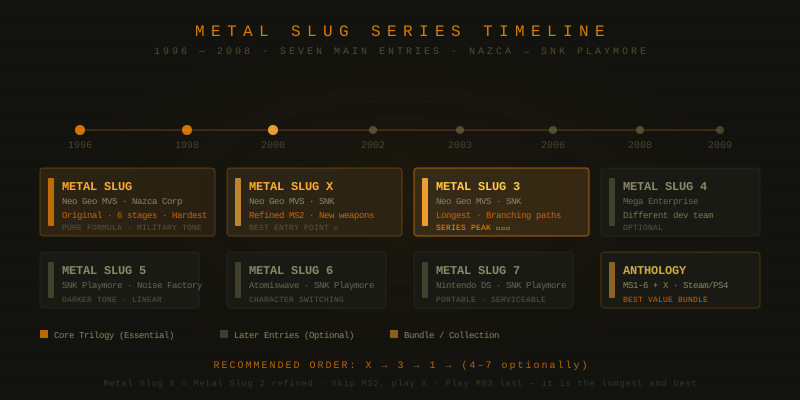 Seven main entries across twelve years — the core trilogy (1, X, 3) is the essential play order.
Metal Slug (1996)
The original is the shortest and hardest. Six stages, four playable characters (Marco, Tarma, Eri, Fio — all mechanically identical), and a visual style that still shocks first-time players in 2026. The pacing is relentless: minimal downtime, frequent boss encounters, and multiple routes through stages that reward exploration.
The tone is military-dramatic rather than absurd. Enemies are soldiers, not aliens or mutants. The final boss is a military commander in a helicopter. The humor is present but understated compared to later entries.
Play it for: historical context, the purest version of the formula, and the most challenging single-player experience in the series.
Metal Slug X (1999)
Metal Slug 2 (1998) introduced new characters, new vehicles, and a heavier emphasis on humor — but it suffered from severe slowdown on the Neo Geo hardware. Metal Slug X is the fix: performance optimizations, rebalanced difficulty, additional weapons, new enemy placements, and visual refinements throughout.
This is the best entry point for new players. It is longer than the original, easier on default settings, funnier, and represents the series formula at its most polished without the extended length and wild divergence of Metal Slug 3.
Play it for: the definitive starting point, the best-balanced difficulty, and the version where the humor and action are most evenly matched.
Metal Slug 3 (2000)
Metal Slug 3 is why the series is legendary. It is longer than the first two games combined, with branching paths that can change the entire route through a stage. The set-pieces are famously creative:
- Stage 1: Beach landing with giant enemy crab — the series at its most conventional
- Stage 2: Zombie outbreak in an airbase. The player can be infected, transforming into a zombie with a unique vomit-blood attack. The stage escalates into fighting alien clones of the player character
- Stage 3: Underground drilling vehicle, insect cave, and a vertical climb through an enemy fortress
- Stage 4: A series of increasingly absurd vehicle sequences — submarine, jet pack, spaceship — culminating in an orbital battle against an alien mothership
- Final Stage: The player rides a missile into space, boards the alien mothership, fights through corridors, escapes, and rides the debris back to Earth
The final stage alone is longer than some entire run-and-gun games. The sheer creative ambition is unmatched in the genre.
Play it for: the definitive Metal Slug experience. This is the one people mean when they say the series peaked.
Vehicle Design
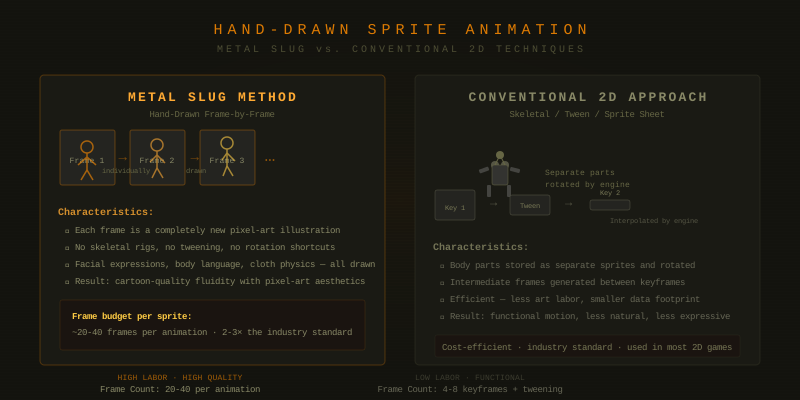 Each sprite was hand-drawn frame-by-frame — no tweening, no skeletal rigs, just raw pixel art.
The series is named after the SV-001 “Metal Slug” tank, a small, agile vehicle with a cannon and machine gun. But the vehicle roster across the series is much larger:
| Vehicle | First Appearance | Capability |
|---|---|---|
| SV-001 Metal Slug | MS1 | Standard tank — cannon + machine gun, can crouch, ejects before exploding |
| Slug Flyer | MS2/X | Fighter jet — fast, air-to-air combat, fragile |
| Slug Mariner | MS2/X | Submarine — underwater stages, torpedoes |
| Slug Gunner | MS3 | Walking mech — slower than standard, but more durable |
| Slug Copter | MS3 | Helicopter — vertical movement, precise aiming |
| Elephant Slug | MS3 | Elephant with mounted weapons — yes, really |
| Camel Slug | MS3 | Camel with a machine gun — for desert stages |
| Ostrich Slug | MS3 | Ostrich — fast ground movement, awkward hitbox |
| Donkey Slug | MS4 | Donkey with weapon mounts |
| Slug Gigant | MS6 | Giant robot — slow, heavily armed |
Each vehicle introduces a different movement rhythm. The submarine requires vertical awareness. The jet pack demands constant motion. The elephant is ridiculous and deliberately awkward. The variety prevents the run-and-gun formula from becoming monotonous across the series’s many stages.
The Humor Is the Design
Metal Slug’s humor is not just incidental charm — it is a structural design choice that makes the game more readable.
- Enemy soldiers visibly panic when the player approaches, giving a clear visual signal that they have been activated and will attack
- The “fat” state — eating too many food pickups makes the character obese, slowing them down but making their melee attack stronger. It is funny but also a meaningful gameplay trade-off
- The zombie transformation in Metal Slug 3 changes the player’s movement, attack, and vulnerability — and it is entirely optional
- Background NPCs provide visual variety and pacing relief: a fisherman catches a giant fish, a tourist photographs the battle, workers frantically repair damaged structures
- Death animations are elaborate and often comic — enemies are launched into the screen, flattened, or turned into skeletons, making crowd control feel satisfying rather than grim
The humor creates a tone where the extreme difficulty (Metal Slug 3 on one credit is genuinely punishing) feels playful rather than oppressive. You laugh when you die, and the game encourages you to enjoy the spectacle of failure.
Author tip: If you only play one Metal Slug, make it Metal Slug 3. Stage 2 alone — where you fight through a zombie-infested airbase, transform into a zombie yourself, and eventually ride a rocket into space — is one of the most creative levels in arcade history. The alien mothership finale is the kind of escalating absurdity that few games even attempt, let alone pull off.
The Later Entries: 4, 5, 6, 7
SNK lost the original Nazca team after Metal Slug 3 (Nazca was dissolved into SNK and key staff departed). The later games were developed by different internal teams and by outsourced studios.
Metal Slug 4 (2002) — Developed by Mega Enterprise (Korea). It feels different — the animation is slightly stiffer, the color palette is less rich, and the level design is less inventive. It is not a bad game, but it is clearly not the original team.
Metal Slug 5 (2003) — Developed by Noise Factory and SNK Playmore. Darker, more serious tone than the earlier entries. The visual quality returns somewhat to the series standard, but the level design is more linear and less ambitious than Metal Slug 3.
Metal Slug 6 (2006) — The Atomiswave arcade board (a Dreamcast-derived platform). Introduces a character-switching system and combines elements from across the series. The increased hardware power allows for more on-screen chaos, but the art direction is less distinctive.
Metal Slug 7 (2008) — Nintendo DS. A respectable portable version with adjusted level layouts for the smaller screen and touch-screen mini-games. Not the ideal way to experience Metal Slug, but a solid handheld effort.
The consensus among fans: play 1, X, and 3. Treat 4 through 7 as optional if you want more Metal Slug and have exhausted the core trilogy.
How to Play Metal Slug Today
ACA Neo Geo Series (Recommended)
Available on: Nintendo Switch, PlayStation 4, Xbox One, PC (Windows Store)
Hamster Corporation’s Arcade Archives ports are arcade-perfect — the ROM is running in an emulation wrapper with save states, screen filters, and online leaderboards. Individual titles are sold separately: Metal Slug 1, 2, X, 3, 4, and 5 are all available.
This is the best way to play if you want the authentic Neo Geo experience with modern conveniences.
Metal Slug Anthology (2006/2015)
Available on: PC (Steam), PlayStation 4
Bundles Metal Slug 1 through 6 plus Metal Slug X in a single package. The Steam version has occasional input lag issues reported by some players — the ACA versions are more reliable for purists, but the Anthology is the best value if you want the full collection.
Neo Geo Mini / Arcade Stick Pro
SNK’s own mini-consoles include Metal Slug titles pre-installed. The Arcade Stick Pro (2019) includes 20 Neo Geo games including Metal Slug 1, 2, X, 3, 4, and 5. The build quality is solid, and it connects to TVs via HDMI.
Mobile
Metal Slug 1, 2, X, and 3 are available on iOS and Android. The touch controls are serviceable but not ideal for a game that demands precision. A Bluetooth controller is strongly recommended.
Common Mistakes
- Playing Metal Slug 2 instead of Metal Slug X — the original Metal Slug 2 has severe slowdown that X fixes entirely. X also adds new weapons, enemy placements, and visual polish. There is no reason to play 2 when X exists
- Holding onto the tank and dying inside it — eject before the tank explodes. The invincibility frames during ejection will save you, and you lose the tank anyway if it blows up with you inside
- Ignoring melee attacks — the knife/baton/axe does massive damage and has a generous hitbox. In close-quarters sections, melee is often safer than shooting. The fat state makes melee even more powerful
- Starting with Metal Slug 3 — it is the best game in the series, but its length and difficulty can be overwhelming for a first-time player. Start with Metal Slug X, which is shorter and more forgiving
- Not using save states if you are playing casually — Metal Slug is an arcade game designed to eat quarters. There is no shame in using save states to practice stages. The alternative is feeding the game dozens of continues and losing the flow of each stage
- Playing solo when co-op is an option — like Contra, Metal Slug is designed for two players. Enemy counts do not scale down for single-player, and the shared chaos of co-op is a core part of the experience
Editor’s Note
Metal Slug occupies a strange position in gaming history. It is universally admired — the art direction, animation, and visual design are cited as reference points by developers across genres — but the actual games are not as widely played as their reputation suggests.
Part of this is accessibility. For years, the only way to play Metal Slug legally was to own a Neo Geo AES (expensive) or find an arcade cabinet. The modern re-releases have fixed this, but the series still lives in the shadow of its own visual reputation: people know Metal Slug looks incredible, but fewer have experienced how it feels to play.
The game is fast, responsive, and punishing — more punishing than its cartoon appearance suggests. This is a hybrid of Contra’s mechanical precision and a Looney Tunes cartoon’s visual language. The combination is unlike anything else in the run-and-gun genre.
If you have not played Metal Slug: start with X, move to 3, and play the original last as a historical reference. You will understand within ten minutes why this series is still discussed decades later.
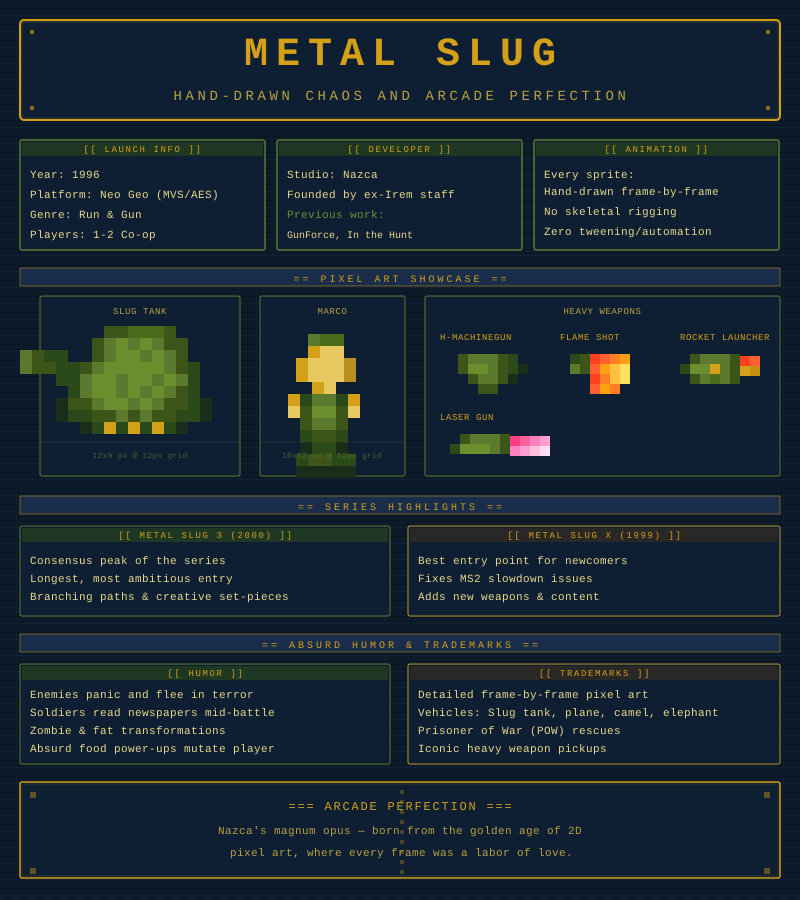 Metal Slug pixel art infographic — 1996 Neo Geo debut, hand-drawn animation, Slug tank, and series highlights
Sources
- Hardcore Gaming 101 — Metal Slug series: https://www.hardcoregaming101.net/series/metal-slug/
- MobyGames — Metal Slug (Neo Geo) entry: https://www.mobygames.com/game/4619/metal-slug/
- Hamster Corporation — ACA Neo Geo Metal Slug: https://www.hamster.co.jp/american_hamster/arcadearchives/metal_slug.htm
- Metal Slug franchise on Steam: https://store.steampowered.com/franchise/METALSLUG
FAQ
Frequently Asked Questions
- What is Metal Slug?
- Metal Slug is a run-and-gun arcade series created by Nazca Corporation and published by SNK in 1996 for the Neo Geo. It is widely regarded as the peak of hand-drawn 2D pixel art animation in video games, with dense backgrounds, fluid character movement, and absurd humor.
- How many Metal Slug games are there?
- Seven main entries: Metal Slug (1996), Metal Slug 2/X (1998/1999), Metal Slug 3 (2000), Metal Slug 4 (2002), Metal Slug 5 (2003), Metal Slug 6 (2006), and Metal Slug 7 (2008). Metal Slug X is a refined version of 2, and Metal Slug 3 is widely considered the series peak.
- Which Metal Slug is the best?
- Metal Slug 3 (2000) is the consensus best entry — it has the most ambitious level design, the largest variety of vehicles and set-pieces, and arguably the finest animation in the series. Metal Slug X is the best entry point for newcomers. Metal Slug 1 is legendary but shorter and harder.
- Can I play Metal Slug on modern platforms?
- Metal Slug is available on Steam (individual titles or Anthology), Nintendo Switch (ACA Neo Geo series), PlayStation 4/5, Xbox, iOS, and Android. The ACA Neo Geo versions are arcade-perfect ports by Hamster Corporation.
- What makes Metal Slug's art so special?
- Every frame in Metal Slug was hand-drawn — no skeletal animation, no tweening. Each sprite was individually illustrated by pixel artists, giving the game a level of character and fluidity that is still unmatched. Enemies sweat, soldiers flinch, vehicles recoil, and backgrounds are dense with animated details.