The Rise and Fall of Cheat Codes: From Developer Tools to Internet Wikis
↑↑↓↓←→←→BA — every gamer knows this combination. But how were cheat codes born, why did they peak, and why did they vanish from modern games? From the Konami Code to GameShark, from GameFAQs to microtransactions: the surprising 40-year story of cheat codes.
Last updated:
Quick Answer
Cheat codes were born in the 1980s as debugging tools that game developers wrote to test their games. Legendary codes like ↑↑↓↓←→←→BA, IDDQD, and JUSTIN BAILEY were actually shortcuts programmers embedded in games to make their own jobs easier. These codes spread among players throughout the 90s through hardware devices like Game Genie and GameShark, magazines, paid tip lines, and internet sites like GameFAQs.
In the mid-2000s, everything changed. Achievements, downloadable content (DLC), microtransactions, and the rise of online multiplayer rendered cheat codes first unnecessary, then economically disadvantageous. Today, finding built-in cheat codes in a AAA game is nearly impossible — but the cultural legacy these codes left behind lives on in pop culture and in gamers’ muscle memory.
Last Updated
Content reviewed in May 2026. Historical information cross-checked against Wikipedia, IGN, Kotaku, and Den of Geek sources. Release dates and operating principles of Game Genie and GameShark devices have been verified. Current cheat code status compared against modern AAA games.
Who Is This Guide For?
- Retro gamers who grew up in the 80s and 90s and learned cheat codes from magazines or friends
- Younger players wondering why cheat codes disappeared
- Researchers and content creators interested in gaming history and culture
- Game designers looking to understand the role of cheat codes in game design and why they were abandoned
Key Takeaways
- Cheat codes originated from developers’ debugging needs — they were written for programmers, not players
- The Konami Code (1986) became the most famous cheat code in gaming history, referenced in hundreds of games, films, and websites
- Game Genie (1990) and GameShark (1995) were hardware devices that modified game RAM in real time — they physically plugged between the console and cartridge
- GameFAQs (1995) and Cheat Code Central (1997) democratized cheat codes, making free what had previously been distributed through magazines and paid tip lines
- In 2005, the Xbox 360 achievement system became the first major mechanism to penalize cheat code usage
- DLCs and microtransactions turned formerly free cheat codes into paid features: the “unlock all weapons” cheat is now a $4.99 package
- Cheat codes haven’t completely disappeared — they live on through PC console commands, mods, and retro collections
The Beginning: The Developer’s Secret Weapon
The origin of cheat codes isn’t romantic — it’s practical. In the 1980s, game developers couldn’t test every section of a game by playing through it from start to finish. Especially in games with high difficulty levels (Contra, Gradius, Battletoads), testing one section meant clearing all previous sections — which would paralyze the development process.
The solution was simple: programmers added secret button combinations to skip to specific parts of the game, refill health, or unlock all weapons. These codes were intended for the development team only — players weren’t expected to discover them.
The Famicom and NES Era
During the Nintendo Entertainment System (NES) era (1983–1995), games were typically written in Assembly language. Every byte of memory was precious. After embedding debug codes into the game’s code, developers often forgot to remove them — or left them in intentionally. The relatively simple architecture of 8-bit games made it easy to hide and protect these secret commands.
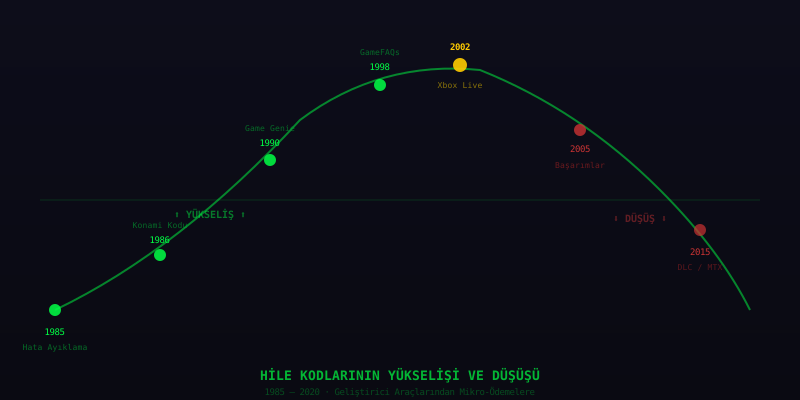 The 35-year journey of cheat codes: from Famicom’s debug menus to the modern DLC era — each turning point reflects a larger shift in the game industry.
The Konami Code: Birth of a Legend
In 1986, Konami was developing Gradius, a space shooter for the Famicom. The game was brutally hard — even developer Kazuhisa Hashimoto struggled to make progress while testing. So Hashimoto added a button combination that was easy to input on the controller but hard to discover by accident: ↑↑↓↓←→←→BA. This code gave the player nearly all power-ups in the game.
Contra and the Explosion
The Konami Code’s real explosion came in 1987 with Contra. Contra is a merciless run-and-gun game where you start with only 3 lives and die in a single hit. Entering the Konami Code on the title screen bumped your lives from 3 to 30. This was the only thing that made the game beatable — and the code spread by word of mouth, becoming a shared heritage of gaming culture.
Why the Code Became So Famous
- Rhythmic structure: ↑↑↓↓←→←→ — like a dance on the D-pad. Extremely easy to memorize.
- Cross-game support: Konami embedded the code in dozens of its games, from Dance Dance Revolution to Metal Gear Solid, from Silent Hill to Castlevania.
- Pop culture: Referenced in countless TV shows and movies including Family Guy, Wreck-It Ralph, and Gravity Falls. Googling the Konami Code makes the page spin.
- Muscle memory: Even 30 years later, someone who’s never held an NES controller can still input the code on a keyboard’s arrow keys.
When Hashimoto passed away in 2020, the gaming world knew it had lost a legend — because the simple combination he created had become the most recognized sequence in video game history.
The Hardware Cheat Era: Game Genie and GameShark
In 1990, Codemasters (UK) and Galoob (US) launched a product that would fundamentally change the gaming world: the Game Genie. This device was a physical adapter that plugged between the game cartridge and the console, working by modifying specific addresses in the game’s RAM in real time.
How Did It Work?
The Game Genie’s operating principle was ingeniously simple: the device “intercepted” the data the console read from the game cartridge and sent modified data back to the console based on the hex code entered by the user. For example, setting the value written to the memory address holding health to 99 made the character invincible.
Each game required different codes. The Game Genie came with a thick code booklet — a yellow-paged book nearly the size of a phone directory, containing ready-made codes for popular games.
The Rise of GameShark
In 1995, InterAct released GameShark for the PlayStation and Sega Saturn. Unlike the Game Genie, the GameShark plugged into the console’s rear port (parallel port or memory card slot) and supported more complex codes. The larger RAM architecture of 32-bit consoles enabled more detailed cheats: changing a character’s height, bending the game’s physics rules, or even activating cut content.
Nintendo’s Legal Battle
Nintendo never liked the Game Genie. In 1990, it sued Galoob for copyright infringement, claiming the device turned the game experience into a “derivative work.” But Nintendo lost the case — the court ruled that the Game Genie did not permanently alter game code, only made temporary changes in RAM. This decision paved the way for hardware cheats and enabled products like GameShark and Action Replay to hit the market.
Magazines, Tip Lines, and Schoolyard Rumors
Before the internet, there were three ways to learn a game’s cheat codes: gaming magazines, paid tip lines, and schoolyard gossip.
Gaming Magazines
Magazines like Nintendo Power, EGM (Electronic Gaming Monthly), GamePro, and in Turkey, Level and Oyungezer published a “Cheat Codes” section in every issue. This was one of the most-read sections of each magazine. Magazines shared exclusive codes they received from publishers and game testing teams, and sometimes published discoveries submitted by readers.
Paid Tip Lines
In the 1990s, America had game advisory services operating over 1-900 phone lines. Nintendo’s own “Nintendo Game Play Counselor” line was billed per minute. Kids stuck in a game would run up their parents’ phone bills asking counselors for cheat codes and strategies. This model was a typical reflection of an era when access to information faced physical and economic barriers.
The Schoolyard Network
In Turkey and around the world, the fastest way cheat codes spread was in schoolyards. A student who learned the Mortal Kombat blood code (ABACABB) from an older sibling or cousin would teach the whole class the next day. This word-of-mouth spread gave codes an almost mystical aura — knowing a code was a status symbol in the gaming community.
The Internet Age: GameFAQs and the Democratization of Information
When Jeff Veasey founded GameFAQs in 1995, the site was a small archive where he published his own game guides. By 1998, it had transformed into a massive community platform where users submitted their own guides and cheat codes.
The Internet’s Impact on Cheat Codes
GameFAQs and Cheat Code Central (1997) completely changed the distribution model for cheat codes:
- Free access: No more buying magazines or calling paid tip lines. All codes were free.
- Community verification: Users tested and flagged incorrect codes submitted by others.
- Instant updates: When a new game released, codes appeared on the site within days.
- Scope: By the early 2000s, GameFAQs had cheat codes for over 100,000 games.
The Paradox
The internet was both the peak of cheat codes and the beginning of their end. Codes were more accessible than ever — but the game industry had already started to change.
The Disappearance: Why Cheat Codes Vanished
The disappearance of cheat codes wasn’t caused by a single event but by the convergence of four major industrial shifts.
1. Achievements (2005)
The Xbox 360’s Achievement system, introduced in 2005, became one of the most powerful tools shaping player behavior. Achievements commodified gaming: finishing the game was no longer what mattered — earning achievements was. And here’s the critical detail: using cheat codes disabled achievements. This instantly turned cheat codes into a “penalized” option. PlayStation Network (2008) and Steam (2007) adopted similar systems.
2. DLC and Microtransactions
The old “unlock all weapons” cheat now appears as a $4.99 weapon pack. “Extra characters” are part of a season pass. “Unlimited money” is a $1.99 “resource pack.” Game publishers turned the functionality that cheat codes offered into paid content. This is one of the clearest examples of the industry’s strategy to transform players from “players” into “consumers.”
3. Online Multiplayer
From Counter-Strike to Fortnite, in competitive multiplayer games, cheat codes were redefined as “cheating.” Problems caused by third-party software like wallhacks, aimbots, and ESP pushed developers to adopt a strict stance against any form of cheating mechanisms. Even in single-player games, the concept of “cheat codes” absorbed this negative connotation.
4. Development Economics
Modern AAA games have codebases spanning millions of lines. Leaving debug menus in the game, testing them across all platforms, and passing certification creates a meaningful cost line item. For studios, there’s no incentive to maintain features that generate zero revenue.
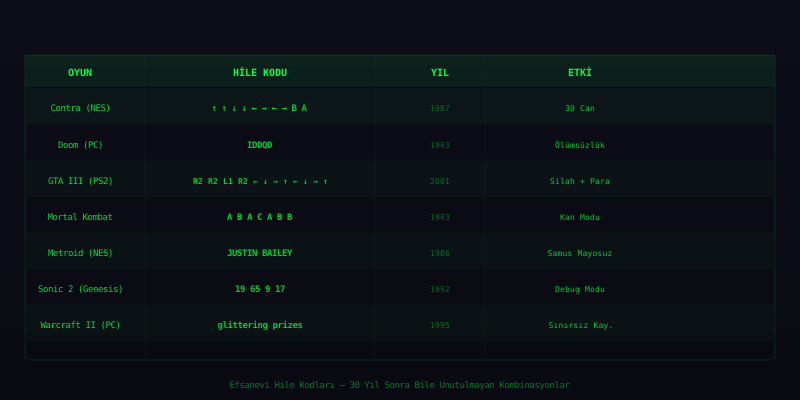 Seven legendary cheat codes etched into gamers’ muscle memory across generations — digital spells unforgettable even 30 years later.
The Value of What’s Lost: What We Lost with Cheat Codes
The disappearance of cheat codes isn’t just a technical change — it’s a cultural loss.
What Was Lost
- Player autonomy: Cheat codes gave players the freedom to experience a game on their own terms. Today, the developer decides how you play the game.
- The thrill of discovery: Finding a cheat code in a magazine or learning it from a friend was an experience in itself. In today’s “everything is on the internet” world, that sense of discovery is gone.
- Community bonds: Codes were a secret shared among players. They brought people together in schoolyards, forums, and magazine letters pages.
- Design flexibility: Developers could design games as two distinct experiences — “normal” and “cheated.” Contra is the best example of this.
Still Alive
Cheat codes haven’t completely vanished. Console commands in PC games (Skyrim’s tgm, The Sims’ motherlode) are still common. GTA V features classic button-combo cheats in its single-player mode. Mod communities continue to transform games in ways developers never anticipated. And retro collections preserve original codes in working condition.
Common Mistakes
- “Cheat codes were only for ruining games.” No. They started as developer tools and were intentionally left in many games (especially Contra) to make them accessible. They were part of game design.
- “Game Genie was illegal.” On the contrary, Galoob won the lawsuit Nintendo filed. The court ruled that making temporary changes in RAM did not constitute copyright infringement. Game Genie was completely legal.
- “The internet killed cheat codes.” The internet actually created the golden age of cheat codes (the GameFAQs era). The real killers were achievements, DLCs, and online multiplayer.
- “There are no cheat codes today.” There are, but in different forms: PC console commands, mods, trainer software. Only the “enter a button combination on the title screen” model is dead.
Author’s Tip
If you really want to understand the magic of cheat codes, try beating Contra on original NES hardware without the Konami Code. 3 lives, one-hit death, limited continues. You’re lucky if you make it past the first two levels. Then enter the code and feel the difference. Cheat codes didn’t “ruin” the game — they let you experience it in a different way. Finding that freedom in modern games is nearly impossible.
Editor’s Note
A numerical perspective: In 2000, a newly released game had about an 80% chance of containing cheat codes. By 2020, that number had dropped below 5%. Over the same period, average DLC revenue per game rose from zero to around $15. The inverse correlation between these two curves is sufficient to explain the fate of cheat codes.
Checklist: Reliving Cheat Code Nostalgia
- Get an NES or Famicom clone (original hardware or modern FPGA like RetroUSB AVS)
- Find a Konami game like Contra, Gradius, or Life Force
- Enter ↑↑↓↓←→←→BA on the title screen
- For Doom (1993): type IDDQD for invincibility. Type IDKFA for all weapons and keys
- Find a Game Genie or GameShark device (still available on eBay) and try “moon jump” or “big head mode” on an old game
- Visit GameFAQs’ early-2000s design on the Wayback Machine and remember the old days
- Try classic button-combo cheats in GTA V single-player — Rockstar is one of the few studios keeping this tradition alive
Sources
- Konami Code — Wikipedia, wikipedia.org/wiki/Konami_Code
- The History of Cheat Codes — IGN, ign.com
- Game Genie — Wikipedia, wikipedia.org/wiki/Game_Genie
- 20 Years of GameFAQs — GameFAQs, gamefaqs.gamespot.com
- Why Cheat Codes Disappeared — Kotaku, kotaku.com
- The Rise and Fall of Video Game Cheat Codes — Den of Geek, denofgeek.com
Frequently Asked Questions
Who created the Konami Code? The Konami Code was created in 1986 by Konami developer Kazuhisa Hashimoto while testing the Famicom/NES port of Gradius. Hashimoto passed away in 2020, but the code he created lives on as a permanent part of pop culture.
What do IDDQD and IDKFA mean? Doom’s legendary cheat codes are entirely a joke. They combine id Software’s (the developer’s) initials “id” with random letters. IDDQD gives invincibility, IDKFA gives all weapons and keys. John Romero has said these codes were chosen during the testing process as “nonsensical but memorable letter sequences that could be typed quickly on the keyboard.”
How were Game Genie codes discovered? Codes were found through brute force. The Game Genie would try every possible hex combination and identify which ones produced on-screen changes. Additionally, ROM hacking communities reverse-engineered game code to manually discover memory addresses. Found codes were then shared on sites like GameFAQs.
How did cheat codes spread in Turkey? Level and Oyungezer magazines published cheat codes for popular games in every issue. Codes spread by word of mouth in schoolyards, arcades, and internet cafes. Turkey’s late arrival to the internet meant this oral culture persisted longer — even in the early 2000s, codes learned from friends were still more common than those from magazines.
Could cheat codes ever make a comeback? A full-scale return is unlikely. But two trends are promising: the popularity of retro game collections (which preserve original codes) and the experimental approach of indie games. Modern retro-style games like Celeste and Shovel Knight keep the spirit of cheat codes alive through “assist mode” accessibility options. This can be seen as a modern, ethical reinterpretation of the old cheat codes.
Frequently Asked Questions
- What is the Konami Code and why is it so famous?
- The Konami Code (↑↑↓↓←→←→BA) is a button combination first used in the 1986 game Gradius (NES) that gave players extra lives or power-ups. It truly exploded with Contra (NES) — the code gave players 30 lives instead of 3, making the game actually beatable. The code became famous because: it has an extremely easy-to-memorize rhythm, it appears in hundreds of games, and it became embedded in pop culture (t-shirts, tattoos, movie references). Today, if you Google the Konami Code, the page flips upside down — the company keeps it alive as an Easter egg.
- How did Game Genie and GameShark work?
- Game Genie (1990) and GameShark (1995) were physical devices that plugged between the game cartridge and the console. They worked by modifying specific memory addresses in the game's RAM in real time: setting health to 99, freezing ammo counts, changing the character's height. Users entered 6-8 character hex codes from the code booklet that came with the device. Game Genie was made for NES/SNES/Genesis, while GameShark was built for PlayStation/N64/Saturn. Both were hardware-level cheats that 'patched' game code in RAM — they operated at the hardware layer, not the software layer.
- Why did game cheats disappear after the 2000s?
- Four main reasons: (1) Achievements (standardized with Xbox 360 in 2005) — using cheats disabled achievement earning, which incentivized players not to cheat. (2) DLC and microtransactions — the old 'unlock all weapons' cheat is now sold as a $4.99 package. (3) Online multiplayer — cheat codes made fair competition impossible, so they were banned in online games. (4) Development costs — leaving debug menus in modern games' complex codebases and testing them requires extra labor. For studios, cheat codes are now a cost item with no return on investment.
- How did GameFAQs and Cheat Code Central become popular?
- GameFAQs was founded by Jeff Veasey in 1995 and by 1998 had become the largest internet resource for game guides and cheat codes. Users submitted codes they found, the community verified them, and they were categorized. Cheat Code Central (CCC) was founded in 1997 and adopted a more visual, ad-supported model. These sites democratized information by making cheat codes — previously distributed through magazines and paid tip lines — free and instantly accessible. In the early 2000s, both sites drew millions of unique visitors per month.
- Can you still use cheat codes today?
- Limitedly, yes. Console commands and mods are still common in PC games. Some AAA games like GTA V still have cheat codes for single-player. In retro game collections (e.g., Rare Replay, Konami Anniversary Collection), original cheat codes still work. However, using cheats in online games (wallhacks, aimbots, etc.) is now called 'cheating' and leads to account bans. Cheat codes today are no longer a game mechanic — they're a nostalgic Easter egg.